Showing posts with label prepared environment. Show all posts

Saturday, December 7, 2013

Our Montessori Non-Nursery

I love, love, love looking at pictures of Montessori nurseries on blogs.  While pregnant with TRex, I dreamed of having such a beautiful nursery. There was one significant setback, however: our apartment is one room shy of a nursery for a baby.  So, I've tried to recreate some of the best aspects of Montessori nurseries with a mobile, temporary twist.  Here's what we do...

1) Mirror in Q-ball's room- This is key for any Montessori baby, so we had to ensure TRex had a mirror. Our toddler's bedroom is an ideal location. Q-ball was excited about its installation as she, of course, sees the mirror as primarily hers and is able to use it for dressing, fixing her hair, and watching herself jump on the bed.  And, while I'm working with Q-ball in her room, TRex is able to hang out in the corner and enjoy the mirror.

 2) A Mobile Mobile- With the lack of a nursery and the lack of any additional space in our apartment (see more posts on adapting Montessori for a small space here and here), we knew that we needed to create a mobile that was not permanent.  My crafty husband and helpful toddler worked together to build a mobile mobile. They used suggestions from here and here.  Our mobiles are from Bella's Casa- TRex loves them!  As you can see in the pictures, we move the mobile wherever there's space at the time.
In one corner of the living room.

In the dining room.

In the other corner of the living room.

 3) High-Contrast Pictures- Given infants still developing eyesight, they are drawn to high-contrast colors, namely black and white. According to Montessorian theory, looking at black and white pictures develops visual discrimination.  Many of the nurseries I envy have beautiful framed black and white pictures hanging a the infant's eye level.  Key features of our non-nursery are cardstock black and white pictures (also from Bella's Casa).  I can set these up wherever I happen to set TRex down.
In the bathroom while I shower.

In the laundry room/kitchen during diaper washing.

Do you have a mobile Montessori practice?  How have you adapted Montessori ideas to fit your home?

Monday, August 26, 2013

A Prepared Environment in a Small Space

    This is the second post I'm doing that focuses on establishing a Montessori environment in a small space.  You can find the first post with ideas for how to store materials here.

    About nine months ago, we moved into an apartment that was about 30% smaller than our previous space.  Q-ball's previous exploration space (You can find some older pictures here.) was quite large and included lots of floor space and lots of shelves, our current living arrangement just does not allow for this sort of space. However, we work hard to ensure that Q-ball still has lots of options for exploration.  Here's what we've done.

1.  Find unique spaces for small shelving units.  As the high temperatures here have been over 100 for the past few weeks, we really didn't see the need for a fireplace.  So, Q-ball's primary prepared environment is a converted fireplace.

2.  Use nooks and crannies. Q-ball's writing/art table is in a small corner near natural lighting and her reading/music shelf fits perfectly next to our family media shelf.  

3. Use Large Baskets.  Baskets are a key feature of any Montessori design.  However, in our small space, I've found that larger baskets are critical as they can easily be placed on the floor for use and then shifted to another place depending on the activity and how many people are in the room at any given time.  We have a basket for stuffed animals, blocks, balls, and a train set.

 
 3. Squeeze items into their "true" location.  Q-ball's kitchen materials (with the exception of her knife) are always assecible in the bottom of our pantry, and Q-ball's set to bathe and care for her stuffed animals along with her personal makeup bag are under the bathroom sink.


Montessori Monday

Tuesday, August 20, 2013

How to Store Toys in a Small Space

         I don't think I've ever been to a Montessori blog or site that shares posts about what is currently on the shelves in their home.  Every month or so, there are tons of new, awesome materials for the child to explore.  This certainly is one of the few things that causes the "keeping up with the Joneses" plague to strike me. I want to get everything I see! But, as I've started to collect materials, I've often wondered, where are all of the items that are out of rotation?  With the neatness and organization stressed within Dr. Montessori's philosophy, I have to assume all of the materials are neatly tucked away.

         But, I must confess, my out-of-rotation materials were a giant mess! We live in a smallish apartment with extra storage, so I ended up throwing things here and there.  In addition to looking terrible and taking up tons of space, it made material rotation time a huge headache.  So, I decided to re-organize. 

This is what everything looked like when I pulled things out of the closets:  AHHHH!

Here are the steps I took to clean up: 

Things were too out of hand to do a true "before" shot, but this is in the beginning stages.
  1. Throw away "Happy Meal Toys."  True, we've only gotten one happy meal for Q-ball (who subsequently lost the accompanying toy about 1 hour later somewhere in the car...), but we've gathered tons of small favorite-toys from birthday grab bags to awesome finds at the park. I got rid of pretty much all of these toys as they really aren't in line with any of the goals for our shelves.
  2. Group items by type.  My previous problem was when I was looking for a certain object, I didn't know where to start looking.  I'd tried labeling boxes, but as I was consistently rotating materials, the labels didn't do much good.  By grouping items by generic type (sensory, puzzles, blocks, music, bead activities, etc.), I can still label my boxes. 
  3. Package items individually, when possible.  Here, I grouped blocks in paper bags and reused boxes.  I have also seen people use the plastic, zipper bags that come with new sheet sets and mattress pads for this task- that way you can see inside!
  4. Label boxes.
  5. Find a place to stash. This step has been the toughest for me given our current storage limitations.  For larger items, I used large storage tubs.  For smaller items, I used a hanging shoe organizer and a larger hanging closet organizer.  


    Montessori Monday

Monday, June 11, 2012

Our Montessori Environment for a Young Toddler

  I have not shown off any of the changes we have made to our Montessori environment since Q-ball has become a young toddler.  At nearly 15 months old, she is extremely mobile (running and jumping are favorites), can reach for doorknobs, opens cabinets, and just generally gets into anything she can get her hands on.  So, we certainly needed a few updates from the treasure baskets that she used to love.  Here is her new space!

In the kitchen: Q-ball does still have a kitchen treasure basket on the bottom kitchen shelf. She is able to access the bowls and containers on the other shelves to stir and/or bang while Mama is cooking.


Q-ball's table. She loves playing musical chairs! And her stacking tree!
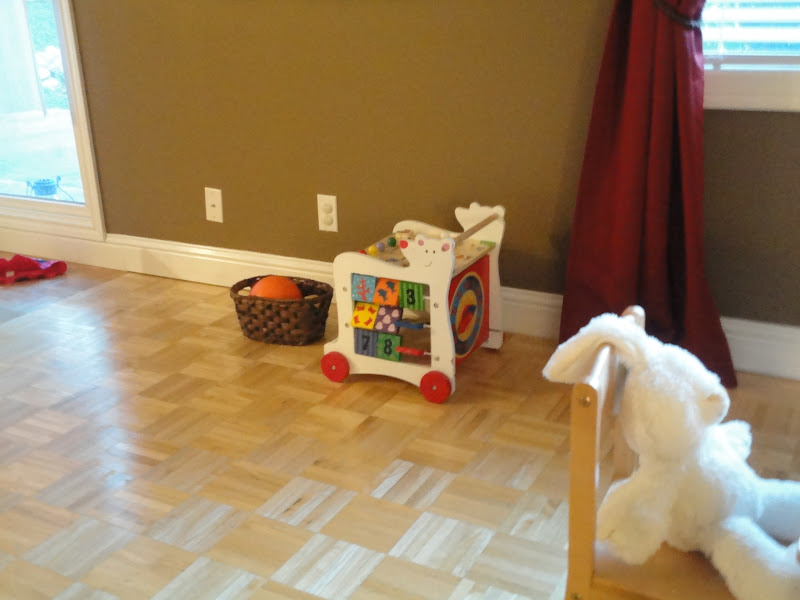
This is her active corner. A basket full of different sized balls to toss, roll, and kick. And, her constant favorite walking wagon which is uses to run circles around the room.

This shelf gives her the opprotunity to practice her new favorite activities: "vrooming" cars and practicing fine motor skills with a Montessori-inspired coin box.
In the living room: Q-ball has six shelves.  They allow her to explore sound, touch, and sight.
A nature basket, homemade rattles, a dressing frame with a zipper made by Grandma, a simple puzzle, and lots and lots of books! ( We love reading right now!)

And, my beautiful homemade mobile above her table.  She's impressed, at least!

What are your young toddler's favorite activities?
Montessori Monday

Sunday, January 15, 2012

Hurdles to Our Prepared Environment

As Q-ball has become more mobile, she has helped us uncover areas of the house that did not pass the prepared environment test.  Over the past few weeks we have work to destroy these hiccups, so Q-ball can get back to exploring with minimum distractions from Mama and Daddy.  As Dr. Montessori stated in regards to creating a children's environment from constraints, "And this freedom is not only an external sign of liberty, but a means of education." None of these ideas are revolutionary; in fact, they are quite obvious. It's interesting that there are some pieces of pre-baby life that are harder to change than others.  Here were are top trouble spots and how we made them baby-friendly.

1.  The blinds on the doors.  Q-ball loved pulling up on these things, and we kinda knew they are likely to break, but we may have waited until it was too late to do something (the story you'll hear will depend upon your relationship with our property manager...) So, in a stroke of genius, we decided to simply raise the blinds! Also, Daddy had to get a screwdriver to remove the fixtures at the bottom of the door to remove the final hazard.
2.  The end table. I had some pictures frames on this end table and a basket of magazines underneath. All of these things were just too appealing to Q-ball.  Again, too easy of an issue to fix- just remove everything!  We also placed this treasure basket where the magazine basket used to be, so it is still an fun area for Q-ball.
3.  Outlets.  Some of the outlets that we use cannot be hidden by furniture.  This was a tough fix because most products just cover outlets that are not being used.  But, we purchased LectraLock to fix this issue.  I should say that while these outlets covers are good for some outlets, we found that we weren't able to use them everywhere. (NOTE: it's probably obvious that a little blog like mine isn't a PR-hub, so this is my honest opinion.) But, I'm still very happy to have them as Q-ball moves very quickly nowadays.  
Foiled by LectraLock!
4. Books, books, books.  Daddy and I have lots and lots of books.  We had them very tightly packed in some lower shelves.  But, Q-ball is just too tricky and strong, and figured out how to get lots of them out.  We removed the books and filled them with surprises for Q-ball to find.  There are still a few books at her level to feel and occasionally pull out, but not so many that Mama doesn't loose control of the exploration.  

5. Hanging Pictures. This past week, Q-ball was frustrated that she wasn't able to see the pictures that we have hanging around the house.  I spent lots of time lifting her to see them, but finally decided that she needed some of her own pictures.  So, I ripped apart our 2011 calendar and hung the pictures at her level. She really loves it! And, at no cost to me! The calendars work perfectly because they are a material that she cannot easy tear (and then eat), and the images are clear and simple. I'm planning to pick up some more as the 2012 calenders go on sale so that I will be able to rotate the images. Assuming that Sports Illustrated are the not only ones remaining.


Have you found areas in your house that were harder to change post-baby than others?  Or, do you still have places that you haven't quite got around to changing??

Source:
Montessori, M. (1912). The Montessori method: Scientific pedagogy as applied to child education in "The children's houses." Fredrick Stokes Company: NY.

Friday, December 30, 2011

Rousseau's "Natural Education" Method

    In yesterday's post, I mentioned and quoted Rousseau and his belief in a child-centered education, but I realized that many, even those who have studied educational philosophies and educational psychology may not realize Rousseau's influence in this field.  (I say this as he was not mentioned in my initial educational psych courses, but he did play a prominent role in my political thought courses.)  Given that I have not discussed a philosopher or researcher in some time, I will devote this Science Friday to Rousseau's work and subsequent development of his beliefs toward education.  
    Much of Jean-Jacques Rousseau's work was focused on the "natural man."  He believed that man, left to his own devices, is good but is corrupted by society, as he more eloquently states in his famous beginning line to The Social Contract, "Man is born free, and everywhere he is in chains."  With this idea in mind, it makes sense that Rousseau's work on child development and education would focus on natural education, free from societal influences.
   In Emile, written in 1762,Rousseau describes a fictional boy (Emile) whom he raises and tutors according to what he believes is nature's plan for child development.  Rousseau believed that education happens naturally, through everyday experiences, as Rousseau stated, "We begin to learn when we first begin to live; our education begins with ourselves, our first teacher is our nurse."
    According to this theory, it not is necessarily to teach towards an ultimate goal of being "a magistrate, a soldier, nor a priest." Indeed, nature alone allows children to develop in their own time without the outside assistance of adults. Rousseau identified four stages (from infancy to adolescence) of child development and the natural urges that ultimately lead to mastery of skills associated with each stage.  Rousseau argued that education must be individualized, meeting the developmental level and natural curiosities of each person. Thus, constant observation of the individual's abilities and interests is essential. 
     Here, I will explain Rousseau's beliefs about infancy, as Q-ball (9 months yesterday!) is in this stage. 
  1. Infancy (birth to 2): 
  • Importance of Breastfeeding:  Before I reviewed Emile for this post, I had never heard about Rousseau's stance on breastfeeding, but I found it very interesting, and will make a special point of discussing it here.  Rousseau strongly believed that there is "no substitute for a mother's love," and writes what I consider to be an angry rant towards mothers to refuse to nurse their babies and, instead, intrust them to midwives.  In fact, he argues that when mothers begin to breastfeed their own children "mutual affection" will be restored to society and a "natural feeling will be restored to every heart."  
  • Sensory Exploration: Babies expereince the world through their senses.  They want to touch everything, which allows them to learn about the temperatures, weights, and textures of objects.  Rousseau removed all unsafe objects from his house, allowing Emile to touch anything he wanted, even bringing Emile objects that he desired but were out of reach.  However, he did not allow Emile to rule over him- Rousseau only granted Emile's wishes when they furthered his learning.
  •  Language Development: The first signs of learning to speak occur during this stage.  Rousseau did not think it was necessary to force or teach language- it is a natural occurrence.  In fact, he believed that lessons would backfire as the grammar infants develop is often better than that of adults.  Additionally, by intervening, adults do not allow the inevitable self-correction of the student.
   Rousseau's goal in education, then, is for children to draw their own conclusions from their personal experiences in their own time.  He believed this is nature's intent.  As Emile was a fictional boy, there was no actual demonstration of how natural education would work. However, his ideas are put in practice in the Montessori Method.  Dr. Montessori strongly supported Rousseau's goals and educational philosophies.  It should be noted, however, that her on methods are not entirely derived from Rousseau, but they share the same underlying educational goals. 
    In our household, we share Rousseau's and Montessori beliefs toward child-centered education, although we would not go as far as to say that society will corrupt Q-ball.  We have worked hard to created a "prepared environment" in our home and largely allow Q-ball to go for whatever she wants to explore.  We work to allow her to discover an object's characteristics and purposes on her own. We certainly are not perfect in our attempts, but we hope that our efforts increase her own desires for self-exploration and love of learning as time goes on.    

Sources:
Crain, W. (2011). Theories of development: Concepts and applications. NY: Prentice Hall.
Roehrs, H. (2000). Maria Montessori. PROSPECTS: The quarterly review of comparative
education.
Retrieved from http://www.ibe.unesco.org/fileadmin/user_upload/archive/publications/ThinkersPdf/montesse.pdf.
Rousseau, J. (1762). Emile. (B. Foxley, trans.) London: J.M. Dent and Sons, 1948.

    Tuesday, November 29, 2011

    Baby Exploration Site 1: The Kitchen


             Our goal is to make our house as baby-proof as possible. We want to allow Q-ball to control her own exploration/play while we spend little time saying "no" or redirecting.  I have discussed some of the research that has encouraged us to make this decision already (see Mahler, play, Ainsworth) and will present more as time goes on. We have taken the standard baby-proofing steps (covering outlets, removing breakables, getting rid of poisons, etc.).  But, we have also created what I'll call "baby exploration sites" in each room which keep baby occupied and allows for individual exploration.  This series of posts is just going to showcase our baby-exploration sites as general baby-proofing information abounds.
            The first site I'm presenting is located in the room in which we spend the most time- the kitchen.  Although I've also discussed in this blog about our Montessori leanings (in this sense, presenting objects that stimulate multiple senses...), the kitchen contains very few items that have been "placed" for Q-ball to find. One Montessori aspect for which I strive within these sites, however, is to minimize clutter.  So, it's been great for helping me stay organized! This site still contains all of the items I needs to operate our kitchen which have been arranged to accommodate an acitve, exploring baby.  Also, we rent, so there are no structural changes that we have made or that we can make.

    Now, how we play safely in the kitchen.
    1.  The island came with this fun curtain instead of cabinets on the bottom shelving.  I'm sure it was a cost saving measure on the part of the owner's when fixing the house up for renters, but it's perfect for grabbing a baby's attention.  Q-ball is instantly drawn to it because it's so accessible to her and fun to play with itself.  I was worried it could be a hazard because she was try to pull herself up on it, but she seems to know that that is not an option. Also, it eliminates the possibility of pinched fingers. Even if I had my own kitchen with cabinets in the future, I would consider replacing some with curtains because this has worked so well. 
    2. So, all of the items placed in this area are items that are 100% ok for baby.  I've placed the ones that are "more" ok in the front, and frankly, these typically please her long enough that she doesn't make it to the back.  Wooden bowls, baskets, paper plates, bibs, towels, cookie racks, plastic storage stuff.


    Baby-exploration sites require quite a bit of clean-up! 

    Related Posts Plugin for WordPress, Blogger...