Showing posts with label natural parenting. Show all posts

Monday, April 15, 2013

Early Potty Learning the Montessori Way- Our Journey

Disclaimer: This is a long post!  But, do not fear, you don't have to read it all-  I really want it to be helpful for those interested, so I've presented lots of information and lots of the same information in different ways, so you can choose which version works best for you!  If you have questions or tips for other parents, please comment!

Here's what you'll find below:
  • Overview
  • Our Basic Action Plan
  • Summary of Early Potty Learning by Month
  •  What I'd Do Differently
  • Our Favorite Potty Books
Overview
 As I've described in several posts, we began potty learning quite early by current Western standards.  Dr. Montessori considered the "sensitive period" for potty learning from 12-18 months.  We started at 14 months. When I started our journey, I looked for sources and stories from other families for inspiration, but, frankly, I did not find very much. Two of my favorite Montessori blogs had some information (How We Montessori (it was especially interesting to follow this mom's journey as her son and my son are the same age, so we were struggling together!) and Vibrant Wanderings).  Additionally, I used some elimination communication resources (specifically this book and this book) for tips, although we were certainly beyond the timeline for EC.
   It was a very slow road- with many pit stops along the way, but ultimately one that I'm very happy we took.  So, I wanted to share our journey- month by month- with the goal of helping or possibly inspiring other early potty learning families.

Our Basic Action Plan
  1. Introduce potty, when child is interested and comfortable, encourage her to sit on potty.
  2. A few hours of daytime diaperless time.  During elimination, introduce your sign and/or verbal cue.  Move child to potty during/after every elimination and explain that all elimination happens on the potty.  Encourage them to help clean up any messes, but otherwise use no reward or consequence.
  3. Increase diaperless time during the day as understanding progresses.  Move to diaperless time during naps.
  4. Go diaperless outside of the house (use trainers or just bring extra clothes).
  5. Go diaperless at night.
***If at any point, your child is clearly uncomfortable or upset by the potty, put it away for awhile.  You don't want your child to have negative feelings toward the potty!

Short Summary by Month

13 Months
For the first time, I noticed that Q-ball indicating to me that she was "feeling" when she was peeing.  As a baby who was never bothered by dirty diapers, I felt this was a significant change that signaled readiness for potty learning.  For the next few weeks, I researched potty learning (see sources listed above).

14 Months
I finally got around to buying a potty. We just set it in front of Q-ball on day, explained what it was for and waited for her to be comfortable to sit on it.  It really didn't take long- just about a day or two.  At this point, we started going diaperless at home for a few hours a day.  When Q-ball peed on the floor, we would make the sign for "pee" and a "pssss" sound.  We then moved her to her potty and encouraged her to clean up the mess.  We went through lots and lots of towels.  We were lucky that Q-ball did not mind sitting on the potty; if anything, she loves it- we get to read lots and lots of books.  But, no "catching" this month. 

15 Months
Q-ball started to make the sign for "pee" and within the next 10 minutes would normally pee.  Still, we didn't catch every pee.  Mainly, in retrospect, because I do not think I was fully committed.  I was a little too casual about potty learning at this point, I think as a result of reading some Montessori resources over resources completely devoted to potty learning.  When Q-ball signed, I would not completely drop everything and wait on the potty for the next however long.  As a result, I think I missed a real opprotunity at this point to help Q-ball connect a her physical sensations to moving to the potty. 

16 Months
Not much changed.  Diaperless time did increase to any time at home.  One major difficulty for us was that I was never able to figure out Q-ball's elimination schedule.  I kept lots of notes and observations, but, frankly could never really figure out a schedule that was consistent.  Perhaps she started holding her pee very early in the process?

17 Months
Q-ball was obsessed with watching others go potty.  Whenever we were out and someone went into another door, she would look at me and make the sign for "pee" with the "psss" sound.  Also, I was dragged into bathrooms during every outing.  Q-ball herself, however, was not overly interested in eliminating on the potty herself.

18 Months
For the first time, Q-ball moved to the potty herself and peed!  Biggest success yet!  She was very excited and kept looking in her potty to see if it's full of pee, but, alas, we still didn't have too much success.

19 Months
At times, Q-ball catches accidents half-way and runs to her potty, but, mostly, we still go through lots of towels.  I should stress that we sit on the potty A LOT.  Like, Q-ball will ask to sit on the potty for over an hour reading but will not think about peeing.  She definitely holds her pee.  As we still wear diapers when we go out and at night, and I know that she is holding her pee until these times.

20 Months
Stomach bug strikes household for several weeks.  After a traumatizing diaperless experience for Q-ball and Daddy, we decide to take several weeks off potty learning to prevent any major setbacks.  (Q-ball clearly was really disturbed by the incident was begged not to go diaperless during this time.)

21 Months
I really start to take potty learning more seriously this month.  I keep fairly strict schedules for when we sit on the potty, although if Q-ball is clearly upset, I don't force anything. Also, we don't always do diapers when we go out- we also wear cloth trainers. Potty successes daily- mainly when we first wake up and before bed.  But, we also traveled to see family, and Q-ball was not interested or comfortable practicing anywhere other than home.  We took about a week to get back into our schedule at home.  I know that we are still dealing with some pee holding. 

22 Months
Q-ball's "I-got-it!" day finally has struck.  I think that my increased focus on potty learning had a major impact.  Where we once sat on the potty for 15-20 minutes before Q-ball eliminated, now there is success pretty much as soon as we sit on the potty.  We now do not wear diapers outside of the house, although we still have accidents- we just bring lots of extras.  We ordered an extra potty for the car and encourage Q-ball to use the potty before we go into a store, to the park, etc.  Q-ball even took rather easily to pooing on the potty.  While we did have a few instances of holding her poo and some emotional potty experiences and explanations of how it all works, we did not have complete refusal. 

23 Months
I'd been looking for the time to introduce nighttime pottying with Q-ball, nervous that it would be quite dramatic as diapering is part of our very set bedtime routine.  But, one night, Q-ball announced she only wanted to wear pants to bed. So, that answered the question.  A few nights, Q-ball has asked to put on a diaper, and we have her help us lay out her nighttime diaper and tell her it will be close by "in case she needs it." This satisfies her.  We certainly have not been accident-free, but I feel as though we have as many successes as misses.  Her potty is set up in the corner of her room, and, if she calls me into her room at night, I help her sit on the potty (which, I admit, she's not always happy about.) or I quickly lay down a new towel and change pants if necessary.

24 Months
I certainly consider Q-ball toilet-trained by two years old.  She is still hesitant about using a "big potty," but we have been looking at pictures from EC sources of babies sitting on big potties, and she has had success.

What I'd Do Differently
  • I had a difficult time finding Q-ball's elimination schedule, I'd recommend starting to figure this out before going diaperless or immediately upon going diaperless.
  • I was very, very relaxed at first, waiting for Q-ball to always show interest, or ask if she wanted to sit on the potty.  I'd use a bit more of a schedule next time- on the potty every 60 or 90 minutes for a few hours each day.
  • In the early days, Q-ball was uncomfortable pooping on the potty, so I did not force it.  However, it is much easier for a caretaker to anticipate when a child will poop than pee.  I'd recommend continuing to try to master pooping first or along with peeing.  (Some books recommend that poop-learning come first as when a child poops, they as tend to pee.)
Our Favorite Potty Books
Many potty-learning books are for older toddlers.  These were the ones that we found were most helpful in the early days and weeks.  Q-ball really, really studied these books and clearly used them for tips and encouragement.
  • A Potty For Me!  A lift-the-flap book, this was fun for Q-ball.  Also, stressed that the child was proud of her accomplishments rather than external rewards.
  • Potty The most simple potty book we found.  Q-ball (and I) still say "Uh-Hmm-Ha-He! when we really have to use the potty!
  • Even Firefighters Go to the Potty All kids love firefighters!  This was just a fun one to read that encouraged her to sit on the potty for a long period, when necessary.
  • I Want My Potty We found this older book at the library.  While I do not think the author intended it, this became our "poo poo book."  The pictures in the book seem to show the little girl really pushing on the potty- we used these pictures to discussed different methods that can help with pooping (this was especially helpful during Q-ball's poop-holding time.)

Tuesday, January 10, 2012

Discovering a New City and Organic Foods

Welcome to the January 2012 Carnival of Natural Parenting: Experiments in Natural Family Living
This post was written for inclusion in the monthly Carnival of Natural Parenting hosted by Hobo Mama and Code Name: Mama. This month our participants have reported on weeklong trials to make their lives a little greener and gentler. Please read to the end to find a list of links to the other carnival participants.
***

     One of the reasons that I opted to use baby-led solids was that it made more sense to me and sounded easier than traditional baby-food.  Just give Q-ball what we were eating. Selfish, I know. But, as the days go on, I often find myself fixing meals for Daddy and me and thinking, "I can't give this to Q-ball!" The most common reasons are: the the food is too salt-laden because it is a canned vegetable or because of pesticides in fresh, conventional produce.  So, I asked myself, if Q-ball shouldn't eat it, should my husband and I be eating it?  Thus, I opted to revamp our eating for at least a week (my standard meal planning and shopping schedule) to be as natural and local as possible.   Here's what we did.
THE SHOPPING-
At one of the markets
   First stop- the farmers' markets to pick up produce.  The timing actually worked out perfectly.  My husband and I have always loved visiting farmers' markets, but since moving to our new city, we haven't found the time.  I was excited to learn there are farmers' markets four days of the week here- all across the city!  So, it was a great way to visit different parts of our new town.  We found lots of yummy fresh produce as well as salsas and jellies and bread.
   Second stop- a "local" meat market.  I'd noticed a small, family-owned meat market in the center of town.  Since Daddy likes meat, I thought I'd check it out.  I'd assumed they would sell some local meats and other ingredients and possibly organic/natural meat.  Well, I could not have been more wrong.  The owner's son couldn't even tell me where any of their food came from.  And, to top it all off, most of their meats were frozen (for who knows how long!)   
   Third stop- local natural, grocery stores.  In the past, I have purchased very few packaged organic products, with the exception of my frozen veggie meals and the occasional splurges. Cost has been the primary prohibiting factor in shopping for organic products, but our main grocery store also sells very few organic products.  We live within a five minute walk of a small store that specializes in natural foods.  Q-ball and I have been going a few times a week to get produce for her meals, but this week we expanded our search.  We bought milk, eggs, OJ, pasta, pasta sauce, cereals, bread, coffee- everything we needed for the week.
THE EATING-
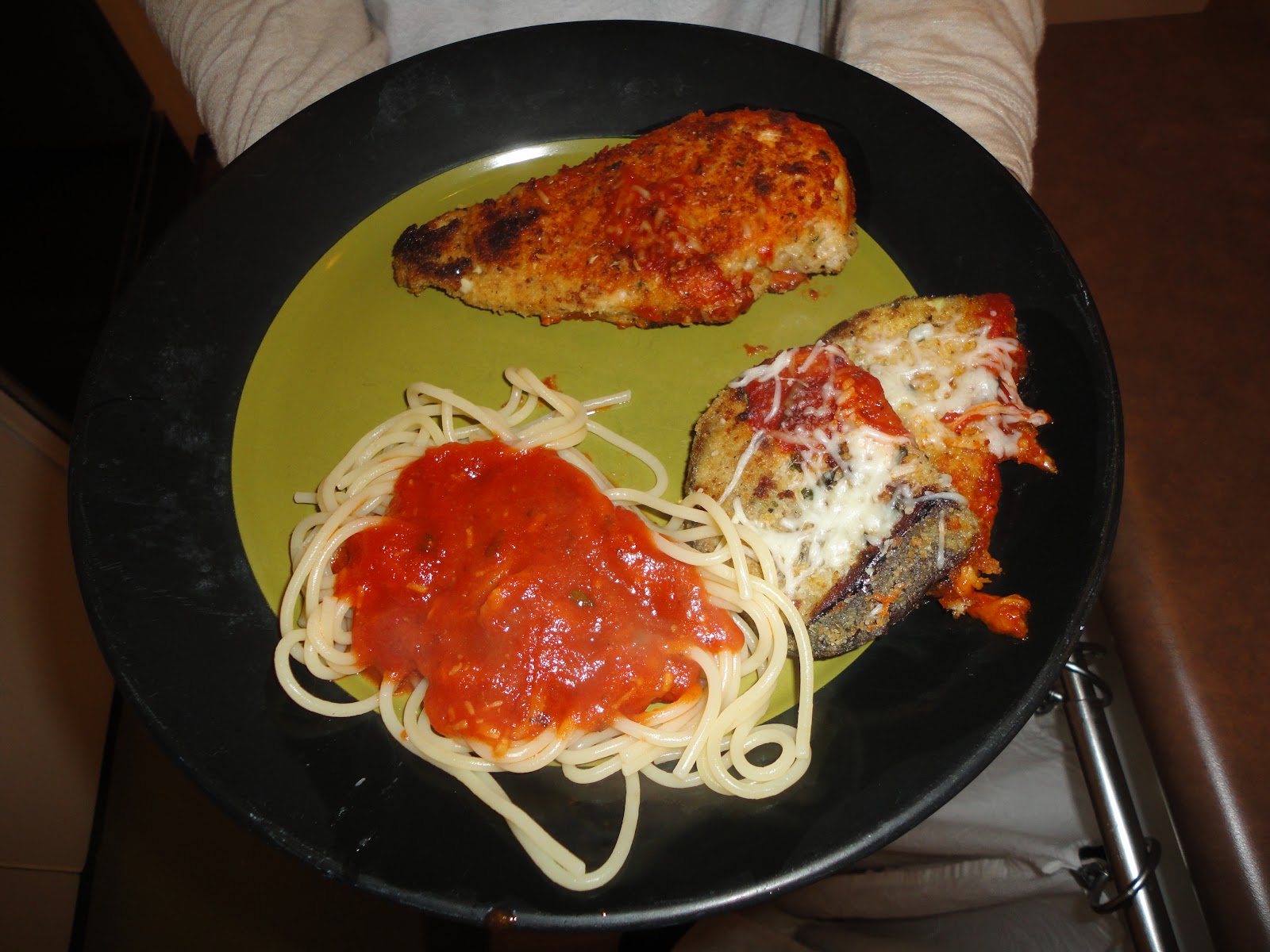
Chicken and Eggplant Parm
   We kept our standard cereal with berries and milk breakfasts and fruit, yoghurt, and sandwiches for lunches, but just ate organic versions.  Some of our dinners included butternut squash and spinach lasagne, a cookout with beef (for Daddy) and veggie (for me) burgers and veggie skewers, crab meat and spinach quiche, and chicken (for Daddy) and eggplant (for me) Parmesan over pasta.
    The food didn't necessarily taste any different than conventional food, but we did eat more fresh (vs. frozen) vegetables than normal.   And, we did get to try some products we never would have otherwise, such as sprouted wheatgrass ziti.  It was delicious!  I'm also now a big fan of sprouted sandwich bread.  The organic spaghetti we purchased was the one item in which I could tell a big taste difference in our normal pasta- the texture and taste were much, much better. 

LESSONS LEARNED-
  1. Plan Ahead.  The selection at some of the markets was more spares than usual because of the holidays, which made finding variety more difficult (luckily we like butternut squash...)
  2. But, not too much. I usually make a pretty detailed weekly meal plan before shopping, but as I did not know all of the ingredients that would be available, so meals were planned at the store.  
  3. Do not assume "local" means local. Out meat shop expereince taught me to always ask about your food.
  4. We love outdoor markets!  I love the fresh fruits and vegetables and other specialty items, and Q-ball loves checking out all of the sites and the attention from the vendors!
  5. Taste.  I was surprised that some of the food did taste better.  I love sprouted bread!
  6. Cost.  It's true that buying organics can be much more expensive than conventional fare, and, as a frugal person, this is what I still struggle with.  However, Charise from I Thought I Knew Mama shared the following a while back that struck a chord with my American and capitalist values,  "every time you go to the grocery store, you are voting." With this idea in mind, I have been more likely be buy organic, despite the price.  
THE FUTURE-
   One of my goals in the next few weeks is to continue to integrate more organic food into our routine by replacing conventional items that I currently have on hand and by trying some new recipes.  I know that I won't buy us organic products 100% of the time, mainly because of price and/or availability.  But, I am now be a much more educated consumer in that I know what products are available and where to get them.  Additionally, I know that if I make some swaps to items that we currently buy (like replacing my cold cereal habit with organic oats), our grocery bill will actually not increase too dramatically, if at all.

   Does your family only eat organics? Why have you made the switch, or why haven't you made the switch? Do you have shopping tips to keep my budget in check or other ways to integrate organics into our routine?


***
Carnival of Natural Parenting -- Hobo Mama and Code Name: MamaVisit Hobo Mama and Code Name: Mama to find out how you can participate in the next Carnival of Natural Parenting!
Please take time to read the submissions by the other carnival participants:

Friday, December 30, 2011

Rousseau's "Natural Education" Method

    In yesterday's post, I mentioned and quoted Rousseau and his belief in a child-centered education, but I realized that many, even those who have studied educational philosophies and educational psychology may not realize Rousseau's influence in this field.  (I say this as he was not mentioned in my initial educational psych courses, but he did play a prominent role in my political thought courses.)  Given that I have not discussed a philosopher or researcher in some time, I will devote this Science Friday to Rousseau's work and subsequent development of his beliefs toward education.  
    Much of Jean-Jacques Rousseau's work was focused on the "natural man."  He believed that man, left to his own devices, is good but is corrupted by society, as he more eloquently states in his famous beginning line to The Social Contract, "Man is born free, and everywhere he is in chains."  With this idea in mind, it makes sense that Rousseau's work on child development and education would focus on natural education, free from societal influences.
   In Emile, written in 1762,Rousseau describes a fictional boy (Emile) whom he raises and tutors according to what he believes is nature's plan for child development.  Rousseau believed that education happens naturally, through everyday experiences, as Rousseau stated, "We begin to learn when we first begin to live; our education begins with ourselves, our first teacher is our nurse."
    According to this theory, it not is necessarily to teach towards an ultimate goal of being "a magistrate, a soldier, nor a priest." Indeed, nature alone allows children to develop in their own time without the outside assistance of adults. Rousseau identified four stages (from infancy to adolescence) of child development and the natural urges that ultimately lead to mastery of skills associated with each stage.  Rousseau argued that education must be individualized, meeting the developmental level and natural curiosities of each person. Thus, constant observation of the individual's abilities and interests is essential. 
     Here, I will explain Rousseau's beliefs about infancy, as Q-ball (9 months yesterday!) is in this stage. 
  1. Infancy (birth to 2): 
  • Importance of Breastfeeding:  Before I reviewed Emile for this post, I had never heard about Rousseau's stance on breastfeeding, but I found it very interesting, and will make a special point of discussing it here.  Rousseau strongly believed that there is "no substitute for a mother's love," and writes what I consider to be an angry rant towards mothers to refuse to nurse their babies and, instead, intrust them to midwives.  In fact, he argues that when mothers begin to breastfeed their own children "mutual affection" will be restored to society and a "natural feeling will be restored to every heart."  
  • Sensory Exploration: Babies expereince the world through their senses.  They want to touch everything, which allows them to learn about the temperatures, weights, and textures of objects.  Rousseau removed all unsafe objects from his house, allowing Emile to touch anything he wanted, even bringing Emile objects that he desired but were out of reach.  However, he did not allow Emile to rule over him- Rousseau only granted Emile's wishes when they furthered his learning.
  •  Language Development: The first signs of learning to speak occur during this stage.  Rousseau did not think it was necessary to force or teach language- it is a natural occurrence.  In fact, he believed that lessons would backfire as the grammar infants develop is often better than that of adults.  Additionally, by intervening, adults do not allow the inevitable self-correction of the student.
   Rousseau's goal in education, then, is for children to draw their own conclusions from their personal experiences in their own time.  He believed this is nature's intent.  As Emile was a fictional boy, there was no actual demonstration of how natural education would work. However, his ideas are put in practice in the Montessori Method.  Dr. Montessori strongly supported Rousseau's goals and educational philosophies.  It should be noted, however, that her on methods are not entirely derived from Rousseau, but they share the same underlying educational goals. 
    In our household, we share Rousseau's and Montessori beliefs toward child-centered education, although we would not go as far as to say that society will corrupt Q-ball.  We have worked hard to created a "prepared environment" in our home and largely allow Q-ball to go for whatever she wants to explore.  We work to allow her to discover an object's characteristics and purposes on her own. We certainly are not perfect in our attempts, but we hope that our efforts increase her own desires for self-exploration and love of learning as time goes on.    

Sources:
Crain, W. (2011). Theories of development: Concepts and applications. NY: Prentice Hall.
Roehrs, H. (2000). Maria Montessori. PROSPECTS: The quarterly review of comparative
education.
Retrieved from http://www.ibe.unesco.org/fileadmin/user_upload/archive/publications/ThinkersPdf/montesse.pdf.
Rousseau, J. (1762). Emile. (B. Foxley, trans.) London: J.M. Dent and Sons, 1948.

    Tuesday, December 20, 2011

    Baby Approved Recipe!

    I enjoyed sharing one of my most successful baby-led solids recipes last week, so I thought I would share one more that would be perfect for a holiday (or any other) party- a baby-led solids version of spinach and artichoke dip. I made it for a recent (and disappointing) football party.  I served it to Q-ball with whole wheat pita, and she loved it! 

    Here's what made this meal good for BLS:
    1) Spinach is full of vitamin A, a nutrient that is deficient in breast-milk fed babies after 6 months.
    2) White beans and artichokes are full of fiber, which many babies need to help with the constipation that is normally associated with introducing solids. 
    3) White beans are also a pretty good source of iron, which is very important for babies as breast milk provides very little iron and most babies have exhausted the iron reserves with which they are born after 6 months.

    From the WHO Guide to Complementary Feeding
    Some notes specific to cooking for babies:
    • I try to use organic ingredients (whether fresh, canned, or frozen) whenever possible for BLS recipes.
    • We do not have any history of allergies. Of these ingredients, Q-ball had previously eaten cheese and whole wheat pita.

    Enjoy!
    1/2 cup fresh Romano or Parmesan cheese
    1/4 cup yoghurt
    1 tsp fresh lemon juice
    1/4 tsp black pepper
    1/8 tsp red pepper
    15 oz. white beans (canned, rinsed and drained or prepared dried)
    6-8 cooked artichoke hearts, quartered (or 14 oz can)
    9 oz. chopped frozen spinach (thawed, drained, and squeezed dry)
    1/2 cup mozzarella cheese

    Preheat oven to 350.  Place all ingredients expect mozzarella, artichoke and spinach in food processor and process until smooth.  Spoon into bowl and add artichokes and spinach.  Place in 1-quart cooking dish, sprinkle with mozzarella and bake for 20 minutes or until browned.

    Sources:
    Department of Nutrition for Health and Development, World Health Organization. (2000). Complementary Feeding: Family 
    http://nutritiondata.self.com/facts/vegetables-and-vegetable-products/2626/2
    http://www.caloriegallery.com/foods/calories-in-cooked-white-beans.htm
    http://www.artichokes.org/health.html

    Tuesday, December 13, 2011

    Baby Approved Recipe!

       Before starting baby-led solids, I spent quite a bit of time looking for information as I did not know anyone else who was choosing to go down this path or anyone else who had done it. For an explanation of why I chose BLS, see this previous post I especially liked reading about other recipes or foods that families were using as I found this was the best way for me to visualize and later employ BLS in my own house.  So, I am sharing last night's dinner recipe- Mediterranean-Inspired Butternut Squash with a side of hummus- as it was our most successful so far.
    Here's what made this a good meal for BLS:
    1) Every member of the family loved it (even meat-eating Daddy), especially Q-ball.  I've rarely seen her so excited to eat. 
    2) The main ingredient- butternut squash- has super high levels of Vitamin A- which is one of the nutrient gaps in babies as breast milk no longer supplies adequate amounts as in babies beyond 6 months.
    3) Hummus (I made a basic homemade hummus)- provides both a low fat (chickpea) and high fat (tahini) source of protein
    4) Easy to serve with couscous or whole wheat pita to provide additional energy for baby.
    5) Lots of exciting new flavors for baby.

    Enjoy! 

    Some notes specific to cooking for babies:
    • I try to use organic ingredients (whether fresh, canned, or frozen) whenever possible for BLS recipes. But, I, admittedly, do not use organic onions or butternut squash as they have been identified as "clean"er by the EWG. It saves a few dollars on groceries.
    • We do not have any history of allergies. I did introduce tahini to Q-ball on its own a few times as nuts are high on the potential allergy list. Whole wheat was also introduced on its own several times before serving with other foods.
    1 butternut squash (2 lbs)
    2 Tbsp olive oil
    1 large yellow onion
    2 cloves garlic, minced
    1/4 tsp cayenne ( I was a little more heavy handed than this, and I think Q-ball needed the hummus to cool off at times...)
    1/8 tsp ground cinnamon
    1/8 tsp ground nutmeg
    1/2 tsp cumin
    1 cup diced tomatoes (fresh)
    1/3 cup raisins
    1 1/2 cups water or reduced sodium veggie broth (I used the later)

    Peel squash and remove seeds. Heat oil in heavy saucepan over medium heat.  Add onion and cook until golden.  Add garlic, cayenne, cinnamon, nutmeg, and cumin.  Cook for one minute.  Add squash, tomatoes, raisins, and water/broth.  Bring to a boil.  Reduce heat, cover and simmer for 10 minutes.  Uncover and simmer until squash is as tender as desired.  


    Adapted from a recipe from Real Simple magazine.

    Sources:
    Department of Nutrition for Health and Development, World Health Organization. (2000). Complementary Feeding: Family foods for breastfed children. Retrieved from http://whqlibdoc.who.int/hq/2000/WHO_NHD_00.1.pdf
    Nutrition facts and analysis for squash. http://nutritiondata.self.com/facts/vegetables-and-vegetable-products/2648/2

    Friday, November 25, 2011

    That Was Stinky...

                While it often seems to be an overlooked sense, a human’s sense of smell is a remarkable ability.  Smells allow humans to assess their environment for dangers (as in the ability to detect and avoid rotten meat) and can even serve as a way for humans to communicate (as is demonstrated by research that indicates that smell plays a critical role in human attraction.)  An infant’s sense of smell is especially remarkable.  A fetus even experiences smells as his mother does; in fact, living in amniotic fluid actually heightens some smells for the fetuses (while I knew about the mother-fetus taste connection, I was surprised to learn this!)
                At birth, newborns can distinguish as many smells as adults- somewhere between 4,000 to 10,000 (big difference, but there seems to be some conflicts among olfactory theorists…) The smell that is most identifiable to newborns (especially newborn girls, the effect is seen much less in boys), though, is the smell of their mother’s breast.  They can actually distinguish their mother’s breast from that of another woman. 
                While infants have very developed olfactory systems, they do not yet have the ability to distinguish good smell from bad smells.  Experiments have shown that even when really stinky stuff (like “simulated feces”) is put in a 2-year-old’s play space, they hardly notice.  (Maybe this is some innate survival skill??)  But, by age 3, humans can determine whether something smells good or bad (known as odor hedonics.)
                Which is what led me to start researching this post- I like things to smell good.  My house, my car, my clothes. Most of the products I use at home have no added fragrances (laundry stuff and cleaning products, although vinegar could be considered a pretty strong fragrance at times…)  But, I do like plug-ins, candles, and Scentsy products.  But, this week Q-ball reached a much-less celebrated milestone- she had her first “it doesn’t smell like breast milk anymore” diaper.  This is obviously a challenge to my smell-good house. 
    But I have been hearing and reading more about “toxins” in these fragranced products which makes me hesitant to use them around Q-ball.  Most of what I have read has provided no actual information other than “fragrances have toxins,” so I decided to delve a little deeper.

    Here’s what I found-
    In 2007, the Natural Resources Defense Council (NRDC) found that 12 of 14 air fresheners that they tested contained phthalates. Phthalates (pronounced THAL-ates) are a group of chemicals that make plastics more flexible, resistant, or enhance fragrances.  They are found in some cosmetics, food packaging, shower curtains, detergents, flooring, and tons of other daily products. 
    While no study has specifically tested the effects of phthalates in humans, in a 2005 study, the U.S. Center for Disease Control found that phthalates disrupted the endocrine system in test rats, resulting in reduced sperm counts, abnormalities in reproductive organs and systems, and even liver cancer.  Thankfully, for Q-ball and mine’s sake, it appears most effects have been found in males.  For my husband’s sake, it appears we were still able to have Q-ball….Other studies, more specific to fragrances, have found increased instances of allergies and asthma as a result of prolonged exposure.  Some researchers believe that the effects of these chemicals are especially harmful to infants and fetuses. They state that increased levels of phthalates in urine taken for pregnant women and a threefold increase in newborn boys with deformed sex organs over the last 40 years provide enough cause for alarm.
    As a result of these reports, in July 2008 the U.S. Congress prohibited the use of some phthalates in children’s toys and cosmetics. 
                But, not all researchers believe that phthalates are harmful.  The study on test rats mentioned above was later conducted on test monkeys.  The results of this study show that there were no abnormalities in the offspring.  The researchers state that humans are closer to monkeys than humans, so that the effects of phthalates of humans is likely minimal at best. 
    So, how can you establish a yummy-smelling secure base for your family?  As with all parenting decisions, it’s really up to you.  Because the tests haven’t actually been conducted on humans, and research is telling us two different things, some would consider the data inconclusive.  But, I’ve decided, why take any chances?  So, in my house, we’ve gotten rid of plug-ins and candles (these had to go with general baby-proofing anyways…) I’m also planning to place some plants that help remove toxins from the air around our home.  It looks like I might not even be able to kill spider plants, peace lilies, or devil’s ivy.  As for my beloved Scentsys, I’m now using the following recipe- 
    ·         2 Tbsp of coconut oil
    ·         A few drops of essential oils.
    It should be noted that this smell is not nearly as strong as the actual Scentsy fragrances, and in large room probably won’t even be noticed.  But, it can keep a small room free from bad odors, and, since research has shown that my husband and baby probably don’t even notice the smelly stuff, that’s enough for us.

    Have you stopped using fragrances in your house?  Do you have any other natural ideas to keep odors at bay? 

    Sources:
    Eliot, L. (1999). What’s going on in there? How the brain and mnd develop in the first five years. Bantam Books: New York.
    Reineke, R. (2008, January 8). It's right under our noses: The importance of smell to science and our lives [Weblog post]. Retrieved from http://serendip.brynmawr.edu/exchange/node/1751
    http://www.denverplants.com/foliage/html/CleanAir3.htm

    Tuesday, November 15, 2011

    Tips for Travelling

    I did get a new haircut for our new city!
    Well, we are finally pretty much back to normal- new house, 90% unpacked, and we even now have Internet!  It was quite difficult to keep the blog updated without access to the Internet...
             Over the past 2 weeks, Q-ball and I have traveled over several states, slept in five different beds, lived out of suitcases, and without regular access to a kitchen and washer and dryer.  Should you suffer the same fate with an infant, here are the top ten ways that I survived...
    1.       Parenting on demand- Crossing time zones, day-lights savings time, and major shake-ups to a normal schedule obviously affected Q-ball's sleeping, eating, playing, moods, etc.  We had to be extra cognizant of her needs and wants to prevent meltdowns (hers and ours, obviously...)
    2.       Breastfeeding- Can't get much more convenient. Nothing extra to pack or carry.
    1. Babywearing-
    a.        I thought this was essential to get through the airport.  My hands were free for check-ins and security, Q-ball was happy, and I wasn't banging around a heavy carseat while running past crowds.  
    b.       Also, this became totally necessary as days when naps just weren't going to happen under a roof (movers coming and going, maids in the hallways, another new place.)  Some days the only way she would sleep was for me to go on a walk with her in the Ergo. It ended up being great for both of us as I got fresh air and exercise (needless to say, we weren't eating our healthiest.)
    4.       Hand-washing station/cloth wipes- Q-ball was crawling all over the hotel room. After just a few minutes of being on the floor her feet, legs, and hands were be black.  It was gross, but there was little we could do except wash her.  In addition to her normal baths, I would wipe her down with cloth wipes and a pre-made solution of 2 parts water and 1 part baby soap (I keep it in a water bottle with a leak-proof valve top) several times a day. 
    5.       Plan your diapering system.  I already discussed this in a previous post.  If you use cloth have a detailed plan for washing. 
    6.       Pack a nightlight.  The rooms are new to you and baby- not friendly for moving around at night with the lights off.
    7.       Work with the hotel staff.  We often requested room service at specific times to try to accommodate Q-ball’s anticipated naps.  It didn’t always work, but at least we tried.  This was also necessary because we were travelling with our darling cats who needed to be caged for housekeeping.
    8.       Baby-led solids.  I didn’t worry about packing or buying any special solid foods for Q-ball for this trip.  Frankly, I didn’t put much emphasis into her eating solids at all during this trip, but with BLS she ate some toast and bananas from the hotel breakfast bar and some pieces of fruit at lunches.
    9.       Pack an extra-duty  garbage bag to cover the car seat when it is checked on the plane.  I did this previously, but didn’t this time and ended up with a big spot on the car seat.  (Which I subsequently have not been able to wash without a washer and dryer…)
    10.    Pack outlet plugs.  Again, we didn’t do this.  But, it would have been great to have in the rooms we were visiting as the outlets were the first places Q-ball headed for. 

    Monday, November 7, 2011

    I did it! Cleanin' Cloth Diapers by Hand

    We are in the midst of a move.  So, I knew that we would be without easy access to a washer and dryer for awhile (currently 10 days...)  But, I had planned to used cloth diapers throughout the process.  Or, I thought I had.  I made a few grossly inaccurate assumptions.  Actually, just one- that my home-owning, nearly 40-year-old cousin with whom we would be staying for 2 nights owns a washer and dryer.  

    Upon arrival, I discovered he didn't.  Then, I learned fact two- also does not own stopper for his tub.  I guess those things are easily lost.  So, we used disposables for two days.  And, I remembered why I hated them- they are stinky, and we have constant blow-outs. 

    So, when we moved into a hotel, I wanted to get Q-ball back in cloth.  But, I hate hotel washers and certainly don't trust them with washing diapers.  So, I decided to handwash.  This was a bit of an impulse decision on my part (in my defense, I had some poopy diapers that were a few days old.)  I hadn't done any research on how to do it, and I really didn't have the right materials (detergent type, gloves, drying rack.)  But, before I knew it, the diapers were in the tub and my hands were jumping in right after them.  Thankfully, I have a patient husband.

    It didn't seem to be a complete failure, but I have since bought some Rockin' Green (usually just use a free and clear) just to avoid possible chemical burn on hands and because I am more worried about build-up with this method.

    So, if you are traveling and planning on using cloth diapers, here's some advice that should have probably been common sense: 
    1) Make sure there's a washer.
    2) Have a contingency plan, just in case.


    Related Posts Plugin for WordPress, Blogger...