Showing posts with label nutrition. Show all posts

Friday, December 14, 2012

A Toddler's Nutrient Needs

Interested in nutrition for your growing infant or toddler?  Check out my other nutrition posts here!
 
 The other day my husband commented, "You've gone dip crazy!"  And, it's true. I make us 1-3 different kinds of dips each week. But, we love eating them, and they are healthy. At least, I have been assuming they were healthy. I realized I hadn't done much research into toddler nutrition in quite awhile.  So, for this Science Friday, I will explore what the nutrient needs of a toddler are, especially working to find out what drives each of these nutrient needs. I did quite a bit of Internet research and discovered that there is not too much information on toddler nutrition, especially for nursing toddlers. In fact, most sources that focus on feeding children ages 1-5 do not mention nursing, despite the fact that the World Health Organization recommends that children continue breastfeeding until at least 2 years old.
    It is true that the USDA has a MyPlate Food Guide for children, and it's also true this guide does not mention breastfeeding.  Additionally, this guide places a pretty high emphasis on a diet rich in grains and dairy products derived from cows' milk. While no one in our family suffers from any wheat or dairy intolerance, we have seen and felt rather dramatic changes by limiting these products. So, I'm a little hesitant to use this as my only guide. The guide I found most helpful in determining a healthful diet for a toddler is published by the World Health Organization and is available here

Here's a rundown of the five most important nutrient needs of a breastfeeding toddler (of course, there are many more nutrients a growing child needs, but these seem to be most important for growth AND are those in which a toddler is most likely deficient):
  1. Protein, about 16g/day:  This is more protein per pound of body weight than an adult requires!  In addition to aiding with all of the growth a toddler is doing, protein helps a toddler maintain muscular strength, maintain health of ligaments, joints, and tendons, and helps maintain immunity by carrying oxygen throughout the blood stream.  Additionally, protein helps maintain brain cells to help with all of the learning that a toddler is doing!  Found in animal products like meat, eggs, and legumes.
  2. Fat, 30-45% of calories should be from fat:  Most adults run from fat, but it's very important for growing toddlers!  Fats surround nerve cells in the brain, helping to protect it. Fats also aid in the development of the brain and central nervous system.  Additionally, fats add in the absorption of other essential nutrients.  Found in breastmilk, dairy products, oils.
  3. Iron, 7mg/day: Toddlers are almost entirely reliant on foods other than milk and breastmilk for their iron needs as milk is not a source of iron.  As such, a study in 2007 found that 2.7 million children are iron deficient.  Iron is used to make red blood cells, which carry oxygen throughout the body.  Toddlers with iron deficiencies are at risk for developmental delays, including retarded growth and learning difficulties.  Found in meat (especially liver), legumes.
  4. Vitamin A: Aids in bone growth and vision development. Protects against illness.  Found in colorful fruits and veggies- carrots, sweet potatoes, red peppers, spinach, etc. 
  5. Vitamin D: While most people believe that they get enough vitamin D from the sun, new studies are questioning this assumption.  Children especially need vitamin D to help absorb calcium to help build strong bones and teeth.  Found in fish, eggs, and fortified foods.  (Given that we eat very few fortified foods, this is the nutrient that I find is most difficult to ensure Q-ball gets enough of. As such, vitamin D is the one supplement that I give Q-ball.)

With my new knowledge of toddler nutritional needs, I still believe that my dips are a healthy choice for Q-ball!  Here are some of our favorites recipes with a bonus explanation of their nutritional value from yours truly!  (I guess that's the least I could do as I'm clearly borrowing all of these recipes from others.)
  1. Black bean spinach dip: This is a yummy way to get a toddler to eat spinach, a good source of iron.  It's bean-based, so it provides a decent amount of protein and fiber (which, while not mentioned previously, is typically very important for toddlers.) Another added bonus is the salsa- sources of vitamin C, like tomatoes, aid in the absorption of iron.  And, for those of you who are afraid of spinach, I promise you won't notice it!
  2. Chocolate-chip cookie dough: Yes, you read that correctly! And, yes, it's amazing!  High in protein, and with minimal sugar (I typically use 2-3 T of brown sugar for the whole recipe, but I've used less and added stevia drops instead.) Also, a great source of fiber.  And, if you use dark chocolate chips, you'll get the antioxidants in chocolate. 
  3. Sweet Potato Hummus: This combines two amazing foods.  Chickpeas again provide iron, protein, and fiber.  Sweet potatoes add lots of vitamin A and even more fiber.
  4. Avocado-White Bean Dip: Again bean-based, so good for protein and fiber.  The avocado provides extra healthy fats for your growing toddler.
  5. Carrot-Cashew Miso Spread: I found this recipe in the cookbook Clean Start.  The carrots are a great source of vitamin A, while the cashews provide fats.  The miso provides the benefits that come with all fermented foods- high levels of vitamin B and naturally-occurring probiotics. Miso is also high in fiber and antioxidants.  This is also a great way to introduce what might be the acquired taste of fermented foods to newbies. 

Sources:
10 nutrients that every child needs. (n.d.) Retrieved from http://www.babycenter.com/0_10-nutrients-that-every-child-needs_1201019.bc
Coleman, E.(n.d.) Very important nutrients during the toddler stage. Retrieved from http://healthyeating.sfgate.com/very-important-nutrients-during-toddler-stage-6328.html.
World Health Organization. (2009). Infant and young child feeding. Retrieved from http://whqlibdoc.who.int/publications/2009/9789241597494_eng.pdf

Monday, October 29, 2012

The Pumpkin Challenge!

    This blog typically focuses on parenting or Q-ball, but one of the principles of Attachment Parenting is "strive for balance", so I thought I'd talk about one way that I meet some of my own needs for this post. To help celebrate this season and honor my husband's love of pumpkin, I decided to embark on a "pumpkin challenge" for the months of October and November. Each week I am making at least one new recipe that includes pumpkin. I love trying new recipes and exploring food blogs, so I've had a blast!
  A few real-life friends and even a blogging friend have asked me to share what I have made so far. It should be noted that while I love to cook, I cannot claim to have created many stellar recipes on my own, so these are pretty much all links to some of my favorite food blogs. But, in our household we typically avoid dairy, gluten, and sugar. And, I don't eat meat.  So, some alterations are necessary, and I've added my notes to the side. But, we also have a sweet tooth that we satisfy about twice as week...Enjoy!
  • Pumpkin Chai Latte- Forget Starbucks! Make this easy treat at home- it's even better if you make fresh whipped cream for topping!
  • Baked Pumpkin Penne- Here, I used quinoa pasta for a less-gluten and higher protein version. I used almond milk, reduced the amount of cheese, and doubled the leeks.  It honestly wasn't my favorite, but Daddy and Q-ball loved it.
  • Butternut Squash Pizza with Pumpkin Crust- I loved the creativity of this recipe! We just ate gluten this night.  I halved the amount of cheese and doubled the amount of brussel sprouts.  But, I love saucy pizza, and I think this needed more sauce. Next time I'd use a whole butternut squash- it was delicious with the sage!
  • Veggie Enchiladas with Pumpkin Sauce- I loved this recipe!
  • Pumpkin Cream Pie Oat Bran - I actually found this recipe in the cookbook Peas and Thank You and super loved it.  I didn't write it down before returning the book to the library, but this blog does the best job of explaining it.  The secret step she mentions it putting everything in the blender to make it really creamy.  Because of this step, I just used rolled oats instead of oat bran.  But, this blogger is right, you should check out this cookbook!
  • Baked Pumpkin Pie Oatmeal - I used almond milk. 
  • Chocolate Chip Pumpkin bread- just a standard recipe for one of my cookbooks
  • Pumpkin oatmeal, chocolate chip cookies- A recipe I made for a bake sale and saved from a previous cookie swap
  • Pumpkin Muffins- Our favorite version of this classic.  I use whole wheat flour and reduce the amount of sugar and oil.
  • Boston "Scream" Pie- I've made this recipe for four Halloweens now.  It's delicious and pretty!  Wonderful for a party.  But, not at all healthy...


Q-ball painted her pumpkin while Daddy did the carving.


Who are you looking at???

Here's what's coming up:
What are your favorite pumpkin recipes?  I'd really love to hear!!

Friday, April 6, 2012

A Mother's Influence on Her Child's Diet

      Part One of this Science Friday series discussed a variety of ways that parents can influence their children's food choices. I know that I saw at least one finding discussed in Part one's post at our home this week- namely, a child's ability to control their own food intake. For Q-ball's birthday, we gave her sweet yogurt the day before her birthday, and she devoured it!  On her actual birthday, we presented her with her first cake and ice cream and expected the same results, but she barely touched anything!  I guess she knew she had had enough the night before!
And, that's about all the cake and ice cream she ate!
    This post is going to specifically explore a mother's role in her child's eating habits. As one of the studies I read explained, "Mothers are often one of the most influential people in a young child’s life."  It makes sense, then, that the mother is often the one to have the most influence on a child's food choices. Obviously, I'm a mama, so I found this a really interesting topic to research especially as I am working to instill healthy eating habits in Q-ball.
     Many of the studies I found dealing with parental influences on children's eating habits focused on preschool-age children.  However, I did find one that looked specifically at a mother's actions while she was just introducing solids to her child- from 6 months to 1 year. Even at this young age, at least two studies show, how a mother feeds her baby is related to a baby's weight.  Mothers are much more likely to pressure their "skinny" babies to eat than they are "chubby" babies. This is especially interesting as it is rather common knowledge that fat babies are happy and healthy babies. (Good news for Q-ball! Just the other day a 8- or 9- year old boy at the park came up to us and called her fat!) Mothers who were deemed to be "controlling" during feeding according to researchers were more likely to have babies with slow weight gain.  I thought this finding was so sad- mothers might be jeopardizing their babies' health because of perceived cultural norms!  What is especially interesting about this finding is that researchers theorize that the mothers then see their babies' slowed weight gain as a success.  As such, they continue to restrict the children's feeding in the coming years, and, as we saw in the last post, this will likely eventually lead to overeating by the child!  What a cycle!
     On the other side of the food control spectrum is pushing children to finish their food. The method of directing children to eat was discussed in Part One, but this week, I am going to look at the issue from a slightly different angle.  Many mothers actively encourage their children to finish their plates or to take a couple more bites. But, studies have shown these reminders last beyond dinner time.  In one study, children were given pudding to eat in a laboratory setting on multiple occasions.  When the children's mothers were present (not encouraging them to eat- just present), overweight children (this specific study was comparing normal weight children to overweight children) were much more likely to eat more pudding. Not only did they eat more, they ate faster and took bigger bites!  The researchers concluded that in these cases, the mothers were likely contributors to their children's weight.
      Finally, it is difficult to look through too much research that discusses women and food without coming across information about eating disorders. Unfortunately, little research has been done on any possible effects that a mother's eating disorder may have on how she feeds her child.  But, at least one study does compare how mothers with anorexia nervosa (AN), bulimia nervosa (BN), binge eating disorder (BED), and no eating disorders (No ED) feed their children.  No differences appear in pressuring children to eat across the groups. But, it found that mothers suffering from BN and BED were more likely to restrict their children's food intake.  Additionally, these mothers were much more likely to report that their children had anxiety issues and difficulty eating (although the researchers admit it is difficult to determine the causality of this reporting.)   The study is not a longitudinal study, so it cannot tell us the long-term effects on these children's eating habits. However, it is known that the odds of having an eating disorder are influenced by both genetic and environmental factors, so it can be assumed these children would have an increased risk of eating disorders.
   Another blog I follow, Parenting Science, recently published a post about the effect of a mother's weight gain during pregnancy has on the child's weight as an adult. I won't rehash the post, but it turns out that mothers the under-eat during pregnancy increase their babies odds of being obese later in life.  If you are interested, the whole post is available here.
     It's amazing to see the amount of influence that mother's can have on their children's daily habits! What struck me in these studies is that the mother's actions seem so off-hand or slight that she likely does not give them a second thought.  But, the long-term impacts are pretty profound.  It's certainly made me think about how I feed Q-ball and how I eat in front of her.  I vow to no longer eat peanut directly from the jar.  At least in front of Q-ball...

Sources:
Brown, A. & Lee, M. (2011). Maternal child-feeding style during the weaning period: Association with infant weight and maternal eating style. Eating Behaviors, 12. 108-112.
Munsch, S., Hasenboehler, K., & Meyer, A.H. (2011). Is amount of food intake in overweight and obese children related to their psychopathology and to maternal eating behavior? Journal of Psyhcosomatic Research, 70. 362-367.
Reba-Harrelson, L., Von Holle, A., Hamer, R.M., Torgersen, L., Reichborn-Kjennerud, T. & Bulik, C.M. (2010). Patterns of maternal feeding and child eating associated with eating disorders in the Norwegian Mother and Child Cohort Study (MoBa). Eating Behaviors, 11. 54-61.

Friday, March 23, 2012

Encouraging Healthy Eating in Children

      Since writing this post about my family's experiment/experience with only eating organic foods for one week, I have really been analyzing what I feed my family and what changes, if any, should be made to ensure that Q-ball will be eating foods that are best for her as she continues to eat more and more solids. I've read The Omnivore's Dilemma, The Unhealthy Truth and countless blogs (some of the most informative and/or fun: 100 Days of Real Food, Cookus Interruptus, and Food Politics.)  I've also participated in several Slow Food groups meetings sponsored by our local natural parenting group and have learned to make kefir and yoghurt. I'm even trying my own sourdough using the methods from Wild Breads. And, I've talked to trusted friends and family about their ideas and habits involving healthy eating.  But, I realized I hadn't done my usual "straight to the source" research method! I found a lot of information to share- some of which really surprised me. I've actually decided to devote two Science Friday posts to this topic.  This Science Friday post will generally discuss parental influence in developing children's eating habits.  And, a next Friday's post will discuss how a mother's eating habits can affect children's eating habits. 
    To start with, as anyone who has children knows, infants enter this world driven by physical needs- especially that of food!  While infants certainly cannot feed themselves, they do recognize and make known when they are hungry. The AAP recommends that mothers nurse infants "on-demand," i.e. whenever they show signs of hunger. By making this recommendation, the AAP is acknowledging that infants know best when and how much to eat.  Studies have found that young children can regulate their own caloric intake.  In one study, children who drank high-calorie energy drinks early in the day, naturally ate less at lunch, while those that had similar looking drink with few calories in the morning, naturally consumed more energy dense food.  But, as I imagine anyone reading this can attest, our ability to self-regulate, defined as the ability to override an impulse, food consumption is lost overtime (I can certainly attest as the majority of the research for this was completed while I was indulging in a lack-of-sleep induced/overly caffeinated chocolate binge...) This lost of control can be attributed to family's and society's influence on shaping habits as a means of socialization. Researchers have discovered that in regards to eating, parents socialize their children in three ways:
  1. "Interactive partners"- model behavior and convey values and ideals through daily interactions; (Studies show the following: children are more likely to try new foods if their parents are more likely to try new foods, and children whose parents eat more fruits and veggies are likely to also eat more fruits and veggies.)
  2. "Direct instructors"- tell children what foods are healthy and what are junk; reinforce (positively and negatively) children for selecting different types of foods
  3. "Providers of opportunities"-  grant or restrict the opportunities and situations to have different types of foods (One study found that just the accessibility of fruits and vegetables in a home accounted for 35% of the difference in consumption of these foods.)
    Photo credit: artistrymasterworks.com
      Just reading this information might lead one (like me) to think, "Okay, this won't be too hard, I'll just offer Q-ball healthy choices and keep her away from items that are not as healthy."  Well, unfortunately, the research shows that it is not that simple.
    First of all, as many parents know from experience, kids love sugar.  Really, really love it. And, research seems to show this is a biologically motivated preference that lasts until adolescence.  When children and adults were both given combinations of water and sugar to find the balance that tasted the best, adults liked the ratio that equated to about a soft drink. Kids never maxed out on the sugar. There was literally so much at the end of the experiment, that the sugar didn't even dissolve!  This kind of love and biological wiring makes it hard for a parent to make cabbage look appealing.

    Again, this might lead you to believe that you should just ban sugar.  But, studies have found that not allowing children access to snack foods or even limiting access to snack foods (ice cream, cookies, and chips- oh my!) will actually lead to overeating when the kids do get their hands on them. 
Photo credit: whitegadget.com
    Restricting bad foods is not the only method of controlling children's eating habits.  Parents are also famous for encouraging their kids to "take a few more bites" or in some cases "Eat MORE!" healthy foods.  Well, this, too, can have negative effects.  In one study, under parental pressure, 83% of children ate more than they would have. While this may sound great, especially if it meant more healthy food, in reality, forcing more food is simply weakening children's ability to self-regulate. As was previously stated, children know how much of to eat.  But, over time, children gradually lose this ability.  Another study gives different portion sizes of mac & cheese to children ranging in age from 2 to 5.  While the 2-year-olds, simply stopped eating when they were full, the 5-year-olds would continue to eat based on portion size.
    Over the long-term, pressure children to eat healthy foods can even backfire.  Although the short-term effect of pressure to eat results in more food eaten, in the long-term, it is children that are not pressured to eat that eat more healthy foods, according to one study.  Studies have found that when children are pressured to eat healthy foods, they are more likely to dislike them as adults and have negative reactions to different types of foods.
   So, what's a parent to do??  The studies seem to agree on the following:
  1. Trust your child! If he says he is full, he is full!  Children have different rates of growth and body shapes that can influence food intake. Before taking action on your own, talk to your doc if you are concerned about food input.
  2. Offer lots of different healthy foods.
  3. But, don't state that foods are off-limits.  Allow children practice moderation with treats.
  4. Involve children in shopping and food prep.  Use this as a teaching opprotunity.
  5. Set a good example!  Parental influence seemed to be the biggest theme in all studies. If you want your child to eat fruits and veggies you have to eat fruits and veggies!
     If you want to learn more about a mom's habits can influence her children's eating habits, check back next Friday!

How do you encourage healthy eating at home? Do you think your child has the ability to self-regulate? 

Sources:
American Academy of Pediatrics Section on Breastfeeding. (2009). Sample hospital breastfeeding policy for newborns. Retrieved from https://www2.aap.org/breastfeeding/curriculum/documents/pdf/Hospital%20Breastfeeding%20Policy_FINAL.pdf
Galloway, A., Fiorito, L., Francis, L., & Birch, L. (2006). "Finish your soup": Counterproductive effects of pressuring children to eat on intake and affect.  Appetite, 46. 318-323.
Kral, T. & Rauh, E.M. (2010). Eating behaviors of children in the context of family environment. Physiology and Behavior, 100. 567-573.
Kroen, G. (2011, September 26). Kids sugar cravings might be biological. Retrieved from http://www.npr.org/blogs/thesalt/2011/09/26/140753048/kids-sugar-cravings-might-be-biological. 

Friday, February 10, 2012

Breast Milk for Your Sick Baby

  Last Saturday night, Q-ball exhibited her first signs of the common cold- lots of sneezing and a little coughing. I hoped it was nothing as her demeanor, appetite, and sleeping habits were all pretty normal.  By Sunday night, though, it was clear that we were facing our first sick baby. Fortunately, it was a mild case- mainly just congestion with a reduced appetite for solids.  Her appetite for nursing, however, definitely increased.  Sunday night she literally nursed from 11 pm until 5:30 am.  But, on Monday, she was as full of life as ever, but still rather congested.  Using an eye-dropper, I was able to get a little breast milk up her nose, and I believe that it cleared up some of the stuffiness.  She continued to mainly play with, rather than eat, solids, but showed no diminished interest in breastfeeding.  I believe that breastfeeding helped us ward off sickness until 10 months and ensured that our first illness was as mild as it was.  While I am fairly knowledgeable about the wonders of breast milk, based upon our experiences over the last few days, I wanted to look into some research to answer the following questions:
  1. How does breast milk help prevent illness and heal a sick baby?
  2. Do babies tend to nurse more during illness?  And, if so, why?
  3. How does breast milk clear congestion?
How does breast milk help prevent illness and heal a sick baby?
     I guess I shouldn't have been surprised to learn that this answer involves quite a bit of hard scienceHere, I've taken the hard science and attempted to break it down for the political scientist.
        Mama initially helps strengthen her baby's immune system during gestation.  Through the placenta, she provides her baby with antibodies (a.k.a- immunoglobulin, a protein the immune system uses to attack antigens such as bacteria and viruses.)  After birth, Mama continues to give baby antibodies through her milk.  Researchers have uncovered some ways in which breast milk strengthens a baby's immunity, thereby preventing illness and, should illness occur, hasten healing times.  
    Photo Credit: Wikipedia

       One researcher states breast milk contains "direct acting antimicrobal factors." This might be breast milk's coolest trick (other than inducing sleep...)  Antibodies attack antigens by binding with them (see image), preventing the antigen from attaching to any bodily tissue.  Mama actually produces antibodies specific for her baby.  When she breathes in, eats, or even "catches" bacteria from baby's saliva during a breastfeeding session certain viruses and bacteria in the baby's immediate environment, her body begins to produce the antibodies needed to combat these bad guys.  She then provides baby the same protection through her milk. 
        The antibodies that Mama makes are also specially suited for baby in other ways.  (1) These antibodies know to ignore the "good" bacteria in baby's developing digestive system, but have been found to specifically attack Salmonella, E. coli, poliovirus, and rotavirus, just to name a few.  (2) These antibodies do not produce inflammation, which could cause harm to body tissue.  (3) The production of antibodies changes as baby ages, meeting his needs at the time.  So, no matter what the child's age, a nursing mother can provide the correct amount of antibodies.  For a newborn, this means that a teaspoon of breast milk has literally millions of antibodies. While an older infant has less concentrated antibodies as he likely nurses more often. In the case of a nursing toddler, the concentration of antibodies again increasing as nursing likely takes place less often. 
        In addition to antibodies, breast milk provides even more ways to prevent illness.  It contains Oligosaccharides (a type of sugar) which mimics the binding sites that bacteria use in baby's tummy.  So, instead of attaching to baby's tummy, the bad bacteria goes to this sugar chain.  Next, breast milk contains lactoferrin, a molecule that bonds with two atoms of iron.  Many bacteria live off of iron, so by reducing the available iron, lactoferrin stops the growth of these bacteria.  This method of illness prevention is especially effective against Staph. in newborns.  Finally, breast milk, especially colostrum, contains white blood cells which directly attack infections.

       Researchers have also found that breast milk serves as an "immunomodulating agent" which means that it helps strengthen and build the immune system. It seems that breast milk actually helps baby in the long-term, that is, beyond the period for which the baby is breastfed. These findings are rather recent, and research is still being conducted into the hows and whys. But, it has been seen that breast-fed babies produce greater blood concentrations of proteins which attack viruses, even after breast feeding has ceased.  Additionally, evidence has found that breast-fed babies have produce more anti-bodies as a result of vaccinations.  Finally, these babies begin to produce their own antibodies in larger amounts than non-breast-fed babies.

    Whew!  Keep reading!  The other answers are not quite as long!

    Do babies tend to nurse more during illness?  And, if so, why?
       Yes!  Research has found that effective pain relief for infants includes skin-to-skin contact, suckling, and sweet tastes- all factors involved in breast feeding!  Researchers found that infants who were breastfed before, during, or after receiving immunizations demonstrated decreased heart rates, less crying, and less painful expressions than babies who were not breastfed.  It seems that the fat and proteins in milk actually block pain fibers from running down the spinal cord.  Pretty amazing! 

    How does breast milk clear congestion?
       Truthfully, I couldn't find anything scientific on this topic. Just stories of mothers sharing their success stories.  I guess it's a case where we have to trust mother's intuition.  I can only assume that it works in ways similar to a saline rinse. Again, I really didn't find any hard science on the topic.  Just general statements around loosening mucus in the airways. 

    So, in conclusion, breast milk is pretty incredible for sick babies!  In times where I'm exhausted from nursing her every two hours, I'll be thankful that I'm working to avoid having a sick baby


    Sources:
    Efe, E. (2007). The use of breast-feeding for pain relief during neonatal immunization injections. Applied nursing research, 20(1), 10-16.
    Goldman, A. (1993). The immune system of human milk: antimicrobial, antiinflammatory and immunomodulating properties. Pediatric Infectious Disease Journal,8, 664-71.
    Newman, J. (n.d). How breastmilk protects newborns.  Retrieved from http://www.breastfeedingonline.com/HowBreastmilkProtectsNewborns.pdf

    Tuesday, January 10, 2012

    Discovering a New City and Organic Foods

    Welcome to the January 2012 Carnival of Natural Parenting: Experiments in Natural Family Living
    This post was written for inclusion in the monthly Carnival of Natural Parenting hosted by Hobo Mama and Code Name: Mama. This month our participants have reported on weeklong trials to make their lives a little greener and gentler. Please read to the end to find a list of links to the other carnival participants.
    ***

         One of the reasons that I opted to use baby-led solids was that it made more sense to me and sounded easier than traditional baby-food.  Just give Q-ball what we were eating. Selfish, I know. But, as the days go on, I often find myself fixing meals for Daddy and me and thinking, "I can't give this to Q-ball!" The most common reasons are: the the food is too salt-laden because it is a canned vegetable or because of pesticides in fresh, conventional produce.  So, I asked myself, if Q-ball shouldn't eat it, should my husband and I be eating it?  Thus, I opted to revamp our eating for at least a week (my standard meal planning and shopping schedule) to be as natural and local as possible.   Here's what we did.
    THE SHOPPING-
    At one of the markets
       First stop- the farmers' markets to pick up produce.  The timing actually worked out perfectly.  My husband and I have always loved visiting farmers' markets, but since moving to our new city, we haven't found the time.  I was excited to learn there are farmers' markets four days of the week here- all across the city!  So, it was a great way to visit different parts of our new town.  We found lots of yummy fresh produce as well as salsas and jellies and bread.
       Second stop- a "local" meat market.  I'd noticed a small, family-owned meat market in the center of town.  Since Daddy likes meat, I thought I'd check it out.  I'd assumed they would sell some local meats and other ingredients and possibly organic/natural meat.  Well, I could not have been more wrong.  The owner's son couldn't even tell me where any of their food came from.  And, to top it all off, most of their meats were frozen (for who knows how long!)   
       Third stop- local natural, grocery stores.  In the past, I have purchased very few packaged organic products, with the exception of my frozen veggie meals and the occasional splurges. Cost has been the primary prohibiting factor in shopping for organic products, but our main grocery store also sells very few organic products.  We live within a five minute walk of a small store that specializes in natural foods.  Q-ball and I have been going a few times a week to get produce for her meals, but this week we expanded our search.  We bought milk, eggs, OJ, pasta, pasta sauce, cereals, bread, coffee- everything we needed for the week.
    THE EATING-
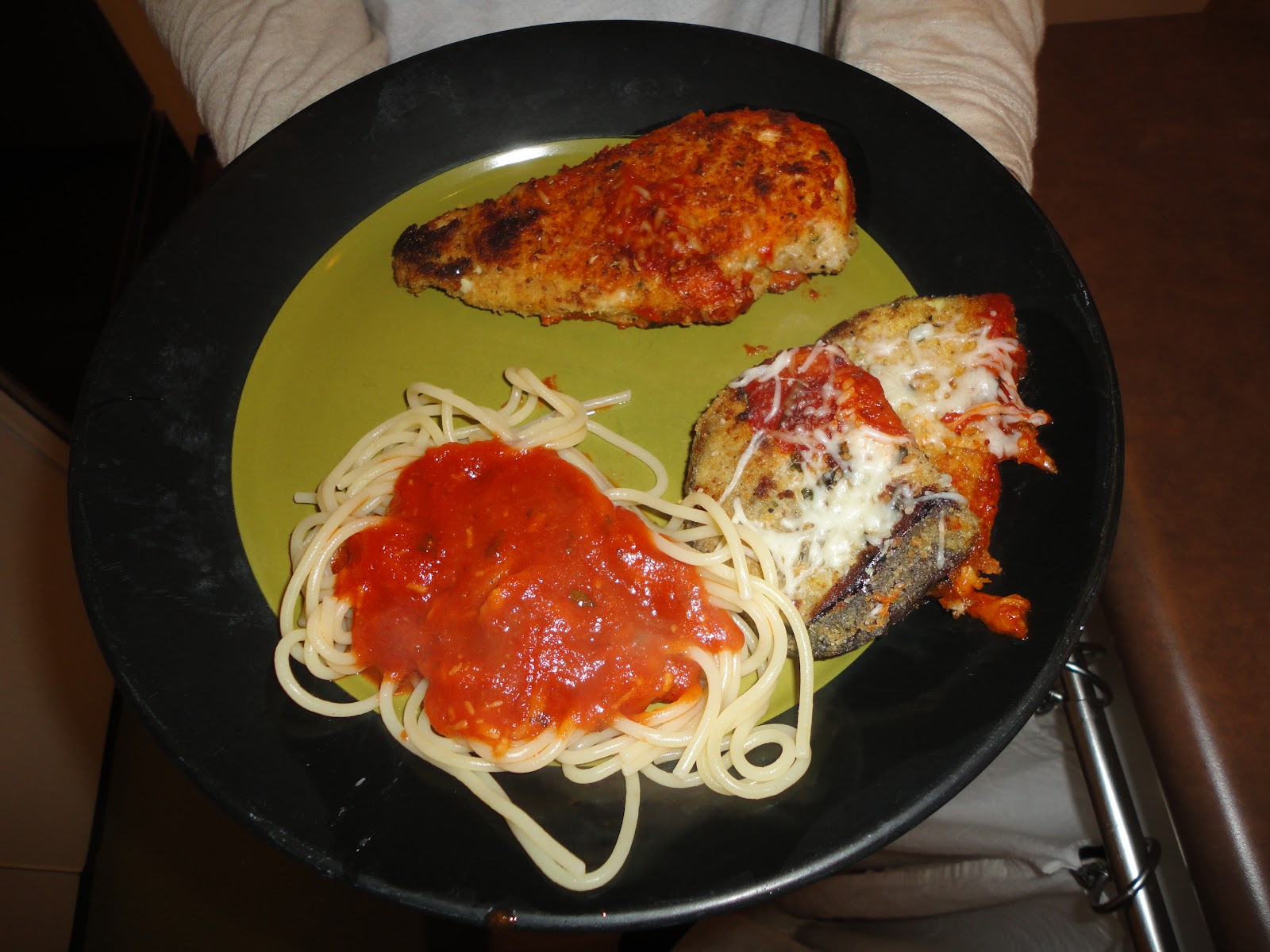
    Chicken and Eggplant Parm
       We kept our standard cereal with berries and milk breakfasts and fruit, yoghurt, and sandwiches for lunches, but just ate organic versions.  Some of our dinners included butternut squash and spinach lasagne, a cookout with beef (for Daddy) and veggie (for me) burgers and veggie skewers, crab meat and spinach quiche, and chicken (for Daddy) and eggplant (for me) Parmesan over pasta.
        The food didn't necessarily taste any different than conventional food, but we did eat more fresh (vs. frozen) vegetables than normal.   And, we did get to try some products we never would have otherwise, such as sprouted wheatgrass ziti.  It was delicious!  I'm also now a big fan of sprouted sandwich bread.  The organic spaghetti we purchased was the one item in which I could tell a big taste difference in our normal pasta- the texture and taste were much, much better. 

    LESSONS LEARNED-
    1. Plan Ahead.  The selection at some of the markets was more spares than usual because of the holidays, which made finding variety more difficult (luckily we like butternut squash...)
    2. But, not too much. I usually make a pretty detailed weekly meal plan before shopping, but as I did not know all of the ingredients that would be available, so meals were planned at the store.  
    3. Do not assume "local" means local. Out meat shop expereince taught me to always ask about your food.
    4. We love outdoor markets!  I love the fresh fruits and vegetables and other specialty items, and Q-ball loves checking out all of the sites and the attention from the vendors!
    5. Taste.  I was surprised that some of the food did taste better.  I love sprouted bread!
    6. Cost.  It's true that buying organics can be much more expensive than conventional fare, and, as a frugal person, this is what I still struggle with.  However, Charise from I Thought I Knew Mama shared the following a while back that struck a chord with my American and capitalist values,  "every time you go to the grocery store, you are voting." With this idea in mind, I have been more likely be buy organic, despite the price.  
    THE FUTURE-
       One of my goals in the next few weeks is to continue to integrate more organic food into our routine by replacing conventional items that I currently have on hand and by trying some new recipes.  I know that I won't buy us organic products 100% of the time, mainly because of price and/or availability.  But, I am now be a much more educated consumer in that I know what products are available and where to get them.  Additionally, I know that if I make some swaps to items that we currently buy (like replacing my cold cereal habit with organic oats), our grocery bill will actually not increase too dramatically, if at all.

       Does your family only eat organics? Why have you made the switch, or why haven't you made the switch? Do you have shopping tips to keep my budget in check or other ways to integrate organics into our routine?


    ***
    Carnival of Natural Parenting -- Hobo Mama and Code Name: MamaVisit Hobo Mama and Code Name: Mama to find out how you can participate in the next Carnival of Natural Parenting!
    Please take time to read the submissions by the other carnival participants:

    Tuesday, December 20, 2011

    Baby Approved Recipe!

    I enjoyed sharing one of my most successful baby-led solids recipes last week, so I thought I would share one more that would be perfect for a holiday (or any other) party- a baby-led solids version of spinach and artichoke dip. I made it for a recent (and disappointing) football party.  I served it to Q-ball with whole wheat pita, and she loved it! 

    Here's what made this meal good for BLS:
    1) Spinach is full of vitamin A, a nutrient that is deficient in breast-milk fed babies after 6 months.
    2) White beans and artichokes are full of fiber, which many babies need to help with the constipation that is normally associated with introducing solids. 
    3) White beans are also a pretty good source of iron, which is very important for babies as breast milk provides very little iron and most babies have exhausted the iron reserves with which they are born after 6 months.

    From the WHO Guide to Complementary Feeding
    Some notes specific to cooking for babies:
    • I try to use organic ingredients (whether fresh, canned, or frozen) whenever possible for BLS recipes.
    • We do not have any history of allergies. Of these ingredients, Q-ball had previously eaten cheese and whole wheat pita.

    Enjoy!
    1/2 cup fresh Romano or Parmesan cheese
    1/4 cup yoghurt
    1 tsp fresh lemon juice
    1/4 tsp black pepper
    1/8 tsp red pepper
    15 oz. white beans (canned, rinsed and drained or prepared dried)
    6-8 cooked artichoke hearts, quartered (or 14 oz can)
    9 oz. chopped frozen spinach (thawed, drained, and squeezed dry)
    1/2 cup mozzarella cheese

    Preheat oven to 350.  Place all ingredients expect mozzarella, artichoke and spinach in food processor and process until smooth.  Spoon into bowl and add artichokes and spinach.  Place in 1-quart cooking dish, sprinkle with mozzarella and bake for 20 minutes or until browned.

    Sources:
    Department of Nutrition for Health and Development, World Health Organization. (2000). Complementary Feeding: Family 
    http://nutritiondata.self.com/facts/vegetables-and-vegetable-products/2626/2
    http://www.caloriegallery.com/foods/calories-in-cooked-white-beans.htm
    http://www.artichokes.org/health.html

    Tuesday, December 13, 2011

    Baby Approved Recipe!

       Before starting baby-led solids, I spent quite a bit of time looking for information as I did not know anyone else who was choosing to go down this path or anyone else who had done it. For an explanation of why I chose BLS, see this previous post I especially liked reading about other recipes or foods that families were using as I found this was the best way for me to visualize and later employ BLS in my own house.  So, I am sharing last night's dinner recipe- Mediterranean-Inspired Butternut Squash with a side of hummus- as it was our most successful so far.
    Here's what made this a good meal for BLS:
    1) Every member of the family loved it (even meat-eating Daddy), especially Q-ball.  I've rarely seen her so excited to eat. 
    2) The main ingredient- butternut squash- has super high levels of Vitamin A- which is one of the nutrient gaps in babies as breast milk no longer supplies adequate amounts as in babies beyond 6 months.
    3) Hummus (I made a basic homemade hummus)- provides both a low fat (chickpea) and high fat (tahini) source of protein
    4) Easy to serve with couscous or whole wheat pita to provide additional energy for baby.
    5) Lots of exciting new flavors for baby.

    Enjoy! 

    Some notes specific to cooking for babies:
    • I try to use organic ingredients (whether fresh, canned, or frozen) whenever possible for BLS recipes. But, I, admittedly, do not use organic onions or butternut squash as they have been identified as "clean"er by the EWG. It saves a few dollars on groceries.
    • We do not have any history of allergies. I did introduce tahini to Q-ball on its own a few times as nuts are high on the potential allergy list. Whole wheat was also introduced on its own several times before serving with other foods.
    1 butternut squash (2 lbs)
    2 Tbsp olive oil
    1 large yellow onion
    2 cloves garlic, minced
    1/4 tsp cayenne ( I was a little more heavy handed than this, and I think Q-ball needed the hummus to cool off at times...)
    1/8 tsp ground cinnamon
    1/8 tsp ground nutmeg
    1/2 tsp cumin
    1 cup diced tomatoes (fresh)
    1/3 cup raisins
    1 1/2 cups water or reduced sodium veggie broth (I used the later)

    Peel squash and remove seeds. Heat oil in heavy saucepan over medium heat.  Add onion and cook until golden.  Add garlic, cayenne, cinnamon, nutmeg, and cumin.  Cook for one minute.  Add squash, tomatoes, raisins, and water/broth.  Bring to a boil.  Reduce heat, cover and simmer for 10 minutes.  Uncover and simmer until squash is as tender as desired.  


    Adapted from a recipe from Real Simple magazine.

    Sources:
    Department of Nutrition for Health and Development, World Health Organization. (2000). Complementary Feeding: Family foods for breastfed children. Retrieved from http://whqlibdoc.who.int/hq/2000/WHO_NHD_00.1.pdf
    Nutrition facts and analysis for squash. http://nutritiondata.self.com/facts/vegetables-and-vegetable-products/2648/2
    Related Posts Plugin for WordPress, Blogger...